Sugar-Free Doesn’t Always Mean Healthy
/By Laura Michelle Powers: Celebrity Psychic, Author, and host of Healing Powers Podcast
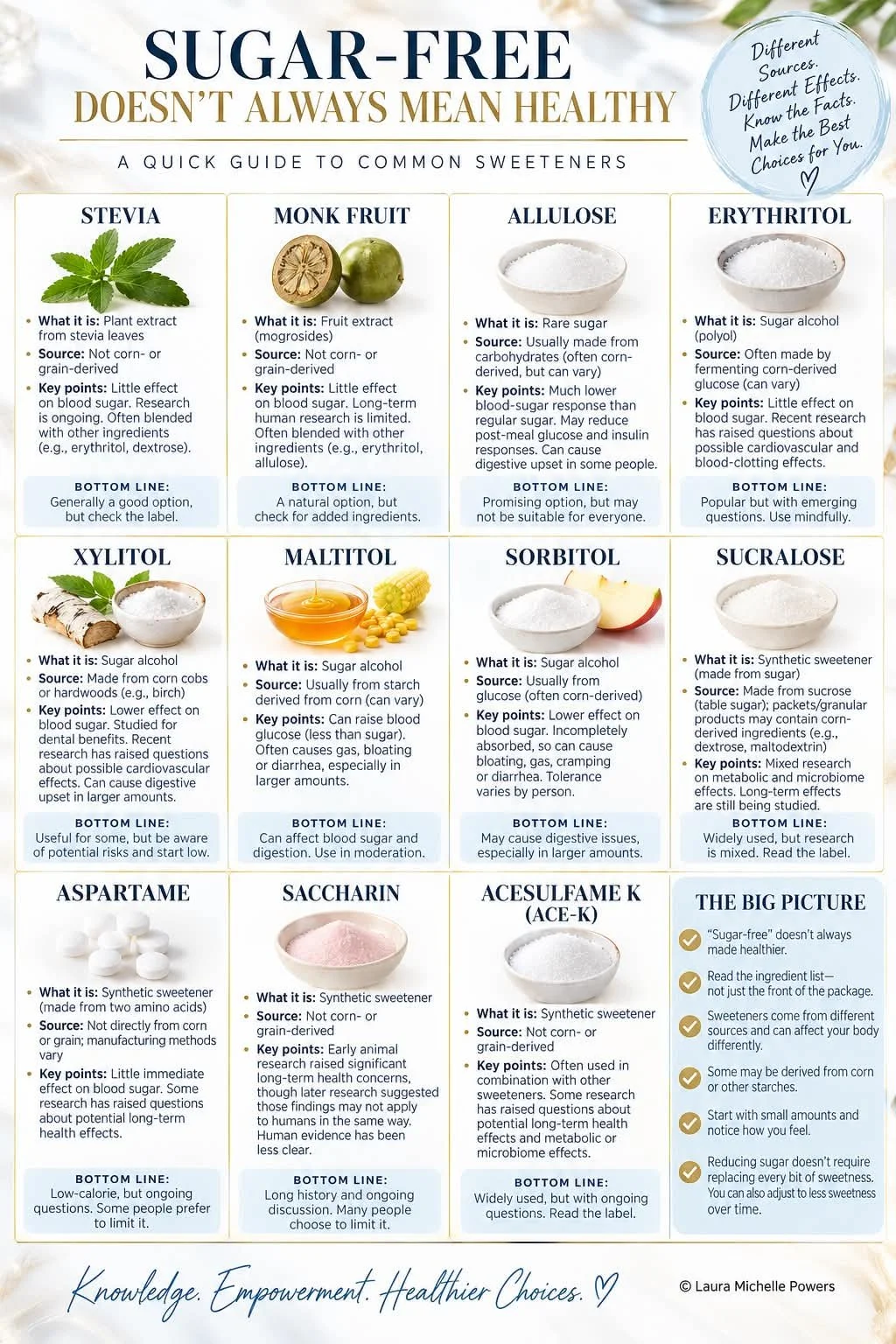
Reducing sugar can be beneficial, but “sugar-free” doesn’t automatically mean healthier. Alternative sweeteners come from very different sources and can affect blood sugar, digestion and potentially other aspects of health differently. Some are plant extracts, some are sugar alcohols, some are synthetic, and some may be commercially produced using corn or other starches. Here’s the quick guide.
First: Read the Ingredient List
This is especially important with stevia and monk fruit. Because the extracts are extremely sweet, manufacturers often combine them with other ingredients to make products that measure and pour more like sugar. A package labeled “monk fruit” or “stevia” may also contain erythritol, allulose, dextrose or maltodextrin—some of which may be corn-derived. Always turn the package around and see what you’re actually getting.
Stevia
Stevia comes from the leaves of the Stevia rebaudiana plant, so stevia extract itself is not inherently corn- or grain-derived. It generally has little effect on blood glucose, although research into longer-term metabolic and microbiome effects continues. The bigger consideration may be what’s added to it: many granulated stevia products contain erythritol, dextrose, maltodextrin or other ingredients that can come from corn or other starches.
Monk Fruit
Monk fruit is a fruit-derived sweetener whose intense sweetness comes from natural compounds called mogrosides. The extract itself is not inherently corn- or grain-derived and generally has little immediate effect on blood sugar. Long-term human research is still relatively limited, however, and many granulated monk-fruit products are actually blends containing erythritol, allulose or other ingredients—so check the label.
Allulose
Allulose is a “rare sugar” that occurs naturally in tiny amounts in certain foods and generally produces a much smaller blood-glucose response than ordinary sugar. Commercial allulose is manufactured from carbohydrate sources, and corn-derived ingredients can be used as the starting material. Human research suggests allulose may reduce post-meal glucose and insulin responses, although evidence for broader long-term benefits is still developing. Larger amounts can cause digestive upset in some people.
Erythritol
Erythritol is a sugar alcohol commonly found in keto and sugar-free products and is often commercially produced by fermenting glucose derived from corn, although manufacturing sources can vary. It has little effect on blood glucose, but recent research has raised questions about possible cardiovascular and blood-clotting effects. These studies do not prove that consuming erythritol causes cardiovascular problems, but they have raised enough questions to warrant further research.
Xylitol
Xylitol is a sugar alcohol that can be manufactured from several plant sources, including corn cobs and hardwoods such as birch—so not all xylitol marketed as a natural sweetener is necessarily birch-derived. It has a lower impact on blood sugar than regular sugar and has been studied for dental benefits. More recent research has raised questions about possible cardiovascular and blood-clotting effects, although a direct cause-and-effect relationship has not been established. It can also cause digestive upset, especially in larger amounts.
Maltitol
Maltitol is a sugar alcohol frequently found in sugar-free candy, chocolate and protein products. It is generally made from starch-derived carbohydrate syrups, with corn and sometimes other starch sources used depending on the manufacturer. Unlike some alternative sweeteners, maltitol can raise blood glucose, although generally less than regular sugar. It is also well known for causing gas, bloating or diarrhea when consumed in larger amounts.
Sorbitol
Sorbitol is a sugar alcohol that occurs naturally in some fruits but is usually manufactured commercially from glucose, which may be derived from corn or other starches. It has less impact on blood sugar than ordinary sugar but is incompletely absorbed by the intestine. As a result, larger amounts can cause bloating, gas, cramping or diarrhea, with tolerance varying considerably from person to person.
Sucralose
Sucralose is a synthetic high-intensity sweetener created by chemically modifying sucrose, or table sugar, rather than being directly made from corn or grain. However, packets and granulated sucralose products may contain dextrose or maltodextrin, which are often corn-derived. Human studies have produced mixed findings, with some research raising questions about glucose regulation, gut microbiome changes and other potential long-term effects.
Aspartame
Aspartame is a synthetic high-intensity sweetener made from components of two amino acids, rather than being directly extracted from corn or grain. Industrial manufacturing can involve fermentation processes whose starting materials vary. While aspartame generally has little immediate effect on blood sugar, some research has raised questions about potential long-term health effects. The evidence isn’t definitive, and research and debate continue.
Saccharin
Saccharin is one of the oldest synthetic artificial sweeteners and isn’t derived directly from corn or grain. Early animal research raised significant long-term health concerns, although later research suggested that some of those findings may not apply to humans in the same way. Human evidence has been less clear, and its long-term health implications continue to be studied.
Acesulfame Potassium (Ace-K)
Ace-K is a synthetic high-intensity sweetener rather than a corn- or grain-derived sweetener. It’s commonly found in diet drinks, protein products and other processed foods, often in combination with additional sweeteners. Some research has raised questions about potential long-term health effects as well as possible metabolic and microbiome effects, although the evidence is not conclusive.
The Simple Takeaway
There isn’t necessarily one “perfect” sugar alternative for everyone. Read the ingredient list rather than relying on the marketing on the front. Consider what the sweetener is made from, what it’s blended with, how much you’re consuming and how your own body responds.
And remember that “corn-derived” or “grain-derived” describes the manufacturing source and doesn’t necessarily mean that the highly purified finished ingredient contains the same components as the original corn or grain. That’s particularly important when distinguishing a dietary preference from a medically diagnosed allergy.
Finally, reducing sugar doesn’t require replacing every bit of sweetness with another sweetener. Sometimes allowing our taste buds to gradually become accustomed to less sweetness is another simple option.
This article is for general educational and informational purposes only and is not intended as medical advice. Research on alternative sweeteners continues to evolve, manufacturing methods vary between companies, and individual responses can differ.